Trump Orders New H-1B Restrictions/Reviews and Extends $100,000 Fee for New H-1B Nonimmigrant Applications
President Trump issued an executive order and a proclamation that, together, impose new H-1B restrictions, direct the Secretary of Labor to review previously submitted labor condition applications, and extend through September 21, 2027, the $100,000 payment requirement tied to certain new H-1B petitions for workers outside the United States.
Below are highlights of the order and proclamation:
- On September 18, 2026, President Trump signed the executive order, Enhancing Program Integrity and Interagency Coordination in the Administration of the H-1B Nonimmigrant Visa Program. The order directs the Secretaries of State, Labor, and Homeland Security to “take into account in any labor condition application, petition, visa, and entry of aliens entering or attempting to enter the United States as H-1B nonimmigrants to perform services in a specialty occupation whether the employer sponsor directly or indirectly engaged in layoffs within the previous year or plans future layoffs that negatively affect the employment of similarly situated United States workers.”
The order also directs the Secretary of Labor, through the Wage and Hour Division, to “begin reviewing data related to previously submitted labor condition applications to determine whether further action against sponsoring employers is warranted.”
- On September 19, 2026, President Trump issued the proclamation, Restriction on Entry of Certain Nonimmigrant Workers, which extends his $100,000 fee on new H-1B nonimmigrant visa applications to September 21, 2027, with certain exceptions, such as for the national interest. Litigation over the $100,000 fee by the U.S. Chamber of Commerce and others remains pending.
Read our client alert for more information on this executive order.
Federal Court Postpones Effective Date of Final Rule Limiting Duration of Status for F, J, I Nonimmigrants
On September 14, 2026, a federal court in Massachusetts issued a preliminary injunction postponing the effective date of a Department of Homeland Security (DHS) final rule that would have replaced duration-of-status (D/S) admissions for F, J, and I nonimmigrants with fixed admission periods beginning September 15, 2026. The ruling preserves the existing D/S framework while the litigation proceeds, affecting students, exchange visitors, foreign media representatives, sponsoring institutions, and employers.
In granting preliminary relief, the court found that the plaintiffs were likely to succeed on the merits of their Administrative Procedure Act claim. That finding is preliminary and does not constitute a final ruling on the validity of the rule. The court scheduled a status conference for October 2, 2026.
The order enjoins DHS from taking further action to implement the rule while litigation proceeds. The court denied requests for vacatur (invalidating the rule) and summary judgment without prejudice, meaning those requests may be renewed later in the course of litigation.
Klasko recommend that employers coordinate with immigration counsel and affected employees before making status, travel, or filing decisions that assume the fixed admission period rule is in effect, since D/S remains the controlling framework. Employers who sponsor F, J, or I visa holders should notify their HR teams, hiring managers, and affected employees that current D/S rules remain in effect until further notice. This update does not change any prior requirements regarding F-1 employment authorization, such as filing timeframes to apply for post-completion Optional Practical Training (OPT) or STEM-OPT extensions, and it does not change I-9 requirements for these forms of employment authorization. Employers, designated school officials, exchange visitor program officers, and international offices are advised to confer with immigration counsel to identify which steps remain appropriate under the current framework.
For more information, read our client alert on what this means for universities, healthcare institutions, and employers.
DHS Proposes to Eliminate 60-Day Grace Period for Certain Nonimmigrant Workers Upon Cessation of Employment Before Authorized Stay Expires Visitors
On September 11, 2026, the Department of Homeland Security (DHS) issued a proposed rule to eliminate the 60-day grace period after cessation of employment before the expiration of a nonimmigrant worker’s authorized period of stay. This includes those with E-1, E-2, E-3, H-1B, H-1B1, L-1, O-1, and TN nonimmigrant classifications.
Written comments must be submitted by November 10, 2026.
Read our client alert for more information on this proposed rule.
DOS Expands Online ‘Screening and Vetting’ of Visa Applicants
On September 18, 2026, the Department of State (DOS) announced that effective October 1, 2026, the agency will “broaden its online presence review” to cover applicants in additional nonimmigrant visa classifications: I (foreign media representatives), TN (U.S.-Mexico-Canada Agreement [USMCA] professionals), and TD (USMCA dependents).
To support this “vetting” process, DOS will instruct all applicants for I, TD, and TN nonimmigrant visas “to set the privacy settings on all of their social media profiles to ‘public’ or ‘open.’ ”
DOS said that the latest announcement expands, to the applicants above, the vetting that currently applies to the following visa categories:
- Diplomatic and official visas: A-3, C-3 (if a domestic worker), G-5
- Students: F-1, M-1, F-2, M-2
- Temporary workers and trainees: H-1B, H-3, H-4 dependents of H1-B and H-3
- Exchange visitors: J-1, J-2
- Fiancé(e)s and dependents: K-1, K-2, K-3
- International cultural exchange participants: Q
- Religious occupations: R-1, R-2
- Witnesses, informants, and victims: S, T, U
For more information on the expansion of visa social media screenings, read our client alert for what this means for applicants and employers.
DOS Cable Acknowledges That DV and IV Pauses Are Lifted
On September 10, 2026, the Department of State (DOS) sent a cable to all diplomatic and consular posts acknowledging that Diversity Visa (DV) and immigrant visa (IV) pauses ordered by the Trump administration are no longer in effect following a court order.
The cable states:
No applicants may be refused under INA 221(g) for either pause. Posts should take steps to identify IV and DV applications previously refused under either pause, and as set out [in the cable], initiate a plan to reconsider those applications, consistent with standard Department guidance and policies.
SAVE and E-Verify Post Updates on TPS for Sudan and Ukraine
Systematic Alien Verification for Entitlements (SAVE) and E-Verify have posted updates on the status of Employment Authorization Documents (EADs) for Temporary Protected Status (TPS) beneficiaries from Sudan and Ukraine.
Both countries’ TPS and related benefits are extended until October 19, 2026.
USCIS Narrows Weekend and Holiday Filing-Deadline Rule
On September 23, 2026, U.S. Citizenship and Immigration Services (USCIS) issued a Policy Alert clarifying when a filing deadline that falls on a Saturday, Sunday, or federal holiday moves to the next business day. Effective October 23, 2026, the extension will apply only when a statute, regulation, or form instruction establishes the deadline in terms of a specified number of days. For example, if the last day of a 30-day filing period falls on a federal holiday, a paper filing received by USCIS on the next business day will generally be timely.
The next-business-day rule will not apply, however, when eligibility is tied to a birthday, age cutoff, or another requirement not expressed as a number of days. Thus, a filing that must be made before a child’s 21st birthday must be received before that birthday even if it falls on a weekend or federal holiday. The alert indicates that the same distinction applies to the one-year asylum filing requirement, which is measured by the anniversary of the applicant’s arrival rather than by a stated number of days. The new guidance reverses USCIS’s broader 2023 policy, so practitioners should file age- and anniversary-based applications before the controlling date rather than rely on the next business day.
NFAP Finds That DHS Wildly Overestimated Revenue From H-1B Fee
On September 24, 2026, the National Foundation for American Policy (NFAP) released a comment on the Department of Homeland Security’s (DHS) proposed rule to impose a $103,265 fee on H-1B cap-subject petitions. NFAP’s analysis concluded, among other things, that DHS overestimated the amount of revenue it would receive from the fee by $6.1 billion annually.
The analysis could contribute to arguments that the fee is meant to deter H-1B immigration, not raise revenue, especially given that only about 700 individuals paid a similar fee before a court struck it down. NFAP also pointed to the likelihood that companies will simply place highly skilled workers in other countries, citing research finding that “companies respond to H-1B restrictions by increasing their hiring in other countries.”

Australia: Skilled Visa Processing Reordered Around Priority Sectors
Australia’s Department of Home Affairs began processing skilled visa applications under two new ministerial directions on September 19, 2026. Ministerial Direction 121 covers temporary skilled visas, including the Skills in Demand (subclass 482) visa. Ministerial Direction 122 covers provisional and permanent skilled visas, including the Employer Nomination Scheme (subclass 186), Skilled Independent (subclass 189), and Skilled Employer Sponsored Regional (Provisional) (subclass 494) visas. They replace the priorities set under Ministerial Direction 119 and apply both to new applications and to applications still pending on September 19.
Both directions give top priority to primary applicants in construction, healthcare, teaching, agriculture, aquaculture, fishing, and resources occupations, and in occupations related to Australia’s law enforcement or defense interests. Home Affairs now processes subclass 482 applications in this order:
- Priority sector applications
- Specialist Skills stream applications
- Other applications from primary applicants in Australia when they applied
- Applications from primary applicants outside Australia when they applied, where the application is not combined with another person’s application
- All other applications
Provisional and permanent skilled visa applications follow the same order, without the Specialist Skills tier.
Philippines: Alien Employment Permit Applications Move Fully Online
Since September 3, 2026, the Department of Labor and Employment (DOLE) has required all Alien Employment Permit (AEP) applications to be filed online, covering new, renewal, exemption, and exclusion requests. DOLE no longer accepts these applications by email, in hard copy, or by walk-in, although cancellation, reprinting, and accreditation requests still go by email. DOLE is also enforcing a zero-contact policy, so questions and status requests must be sent to a designated email address. In-person visits are limited to applicants with a confirmed card release schedule or an official notice to submit additional documents.
Denmark: Launches Collective Agreement-Based Work Permit Scheme for Certified Employers
Denmark will open a new work permit route on January 1, 2027, allowing certified employers covered by collective agreements to hire nationals of 16 designated countries under streamlined conditions.
Denmark’s Parliament approved the legislation on September 3, 2026, creating a pathway that ties foreign recruitment directly to the Danish collective bargaining model. Eligible nationalities currently include the United States, the United Kingdom, China, India, Japan, Canada and Australia, along with several EU candidate countries such as Ukraine and Serbia. To qualify, employers must be covered by a collective agreement concluded within the framework of the Danish Employers’ Association and the Danish Trade Union Confederation, employ at least ten full-time staff, and show at least two years of operations. Certification, handled by SIRI, lasts three years and may be renewed in four-year increments. Certified companies may onboard workers provisionally without waiting for a final decision. Workers must hold a full-time role covered by the agreement and earn at least DKK 322,000 annually, subject to yearly adjustment. An unemployment threshold may pause new approvals if joblessness rises. Employers should assess eligibility and prepare certification applications ahead of the launch.
Ireland: Increased Requirements Proposed for Naturalisation, Including Longer Residence Requirement
On September 9, 2026, the Irish government approved the priority drafting of the Irish Nationality and Citizenship (Amendment) Bill 2026, which would tighten the requirements for citizenship by naturalisation. The Department of Justice, Home Affairs and Migration has since published the General Scheme of the bill. The proposals would:
- Increase the qualifying period of reckonable residence from five to eight years for most applicants;
- Introduce a language test in English, Irish, or Irish Sign Language, along with a test on Irish civics, society, and politics; and
- Require applicants to show they are economically self-sufficient.
The General Scheme will be referred to the Oireachtas Joint Committee on Justice for pre-legislative scrutiny. None of the changes are in effect yet, and they would apply only once the bill is enacted and commenced.
United Kingdom: Multi-Factor Authentication Phased In for Sponsor Accounts
The Home Office began phasing in mandatory multi-factor authentication (MFA) for sponsorship management system (SMS) users on September 3, 2026, and expects every sponsor to have it by November 2026. Once MFA is enabled on an account, users must enter a one-time passcode along with their username and password each time they log in. Level 1 Users with a valid mobile number receive the code by text message, and all other SMS users receive it by email. The Home Office enables MFA automatically for organizations granted a sponsor licence on or after September 9, 2026. Under the updated sponsor guidance, sponsors must keep a current email address on file for every SMS user, along with a current mobile number and correct date of birth for each Level 1 User.
Canada: UK Professionals Now Eligible for CPTPP Work Permits
The Comprehensive and Progressive Agreement for Trans-Pacific Partnership (CPTPP) entered into force between Canada and the United Kingdom on September 1, 2026. Immigration, Refugees and Citizenship Canada (IRCC) has added the UK to its CPTPP instructions for all four categories under the International Mobility Program: business visitors, intra-corporate transferees, investors, and professionals and technicians.
Under the professionals category, UK citizens with pre-arranged employment in Canada may apply for an LMIA-exempt work permit in designated TEER 0 and 1 occupations, including roles in finance, engineering, architecture, the sciences, information technology, and business consulting. Applicants need two years of paid work experience in the relevant sector and must be paid at least the prevailing wage. UK qualifications meet the education requirement if the Canadian client or employer provides a letter confirming they are satisfactory. Initial work permits are valid for up to one year and can be extended.
United States: CBP Introduces Unified Trusted Traveler Mobile App
Travelers enrolled in U.S. trusted traveler programs now have a single official app for managing their membership and clearing entry, after CBP retired two older apps.
CBP unveiled the tool on September 9, 2026, offering it free of charge on iOS and Android. It takes the place of the former Global Entry and Trusted Traveler Programs apps, both of which have been withdrawn. Through the new app, participants in Global Entry, NEXUS, SENTRI and FAST can file and follow their applications, arrange interviews, keep their records current and extend their membership when it nears expiry. Global Entry members can also check in with CBP digitally when returning from abroad, provided they land at an airport that offers the feature. At launch, 85 U.S. airports support it, as do a number of Preclearance facilities overseas. No new account is needed, because travelers log on with their existing details and their data carries over. The underlying programs continue without change. Employers with globally mobile staff may want to flag the switch and encourage travelers to download the app before their next international trip.
United States: September Visa Appointment Wait Times Published
The Department of State updated its global visa wait times on September 17, 2026. The table estimates how long applicants at each U.S. embassy and consulate can expect to wait for the next available interview appointment, broken out by visa category. Estimated waits for petition-based visas (H, L, O, P, Q) at posts in India, China, the Philippines, and Mexico were:
- India: Hyderabad (5.5 months), New Delhi (3 months), Chennai and Mumbai (1.5 months each), and Kolkata (1 month)
- China: Beijing (6 months), Wuhan (4.5 months), Shanghai (3.5 months), Guangzhou (2.5 months), and Shenyang (1 month)
- Philippines: Manila (less than half a month)
- Mexico: Ciudad Juarez, Matamoros, and Mexico City (1 month each), with less than half a month at the other reporting posts
For F, M, and J visas, the longest estimated wait among these posts was in Beijing (5.5 months), followed by Guangzhou, Mumbai, and Wuhan (2.5 months each).
The estimates do not cover applicants who qualify for an interview waiver. Posts release new appointment slots regularly, so applicants may be able to move to an earlier date after scheduling.
United States: Diversity Visa Pause Lifted by Court Order
The U.S. Department of State lifted its pause on diversity immigrant visa issuance as of August 28, 2026, in compliance with a federal court order in Medani et al. v. Trump et al. (N.D. Cal.). The Department had paused issuance in December 2025 to review screening and vetting protocols for the Diversity Visa (DV) program. In the same case, the court temporarily vacated a policy memorandum (PM-602-0193) under which U.S. Citizenship and Immigration Services (USCIS) had held adjustment of status applications filed by DV selectees. USCIS said it would follow the order pending possible further judicial review. Eligibility for DV-2026 ended on September 30, 2026, and selectees who did not receive a visa or status by that date can no longer benefit from their selection.
Brazil: Shifts to Digital Temporary Visas for Nationals Exempt from Tourist Visas
Starting September 1, 2026, citizens of countries that can visit Brazil without a visa can obtain temporary visas through a fully digital process, with no need to surrender a passport or file paper documents.
Brazil’s Ministry of Foreign Affairs announced the change on August 28, 2026. It moves temporary visa processing online for travelers whose nationality already allows visa-free tourist entry. Temporary visas cover longer stays tied to a defined purpose, such as taking up a job in Brazil or working remotely for a company abroad. Under the updated procedure, applicants build their request on the government’s digital consular platform and attach scanned supporting records. Physical files are no longer required, and travelers keep their passports for the entire process. When a request is granted, the visa arrives automatically in the applicant’s inbox. The change should cut lead times for international assignments and spare applicants trips to distant diplomatic posts. Eligibility criteria for each category stay the same, and nationals who need a visitor visa fall outside the update. Employers moving staff to Brazil should verify each assignee’s nationality, make sure the email address on file is actively checked, and carry printed and digital copies of the visa when traveling.
Panama: Revised Minimum Investments Set for Investor Residency
Panama has updated its Qualified Investor permanent residence program through Executive Decree 17 of September 8, 2026, which replaces the decree that had governed the program since 2020. According to an announcement from the Ministry of Commerce and Industries, the minimum qualifying investments under the new decree include:
- New, first-sale real estate: US$300,000
- Resale real estate: US$500,000
- Fixed-term deposits at the state-owned Banco Nacional de Panamá or Caja de Ahorros: US$500,000, a new investment option
The decree also expands the options for investing through the securities market and sets clearer procedures and timelines for processing applications.
Klasko News
FIRM NEWS
Klasko Immigration Welcomes Ian Wilson!
Klasko Immigration Law Partners welcomes Ian Wilson as a Senior Associate on the EB-1 and corporate immigration teams in our Philadelphia office. With more than 15 years of immigration law experience, Ian advises universities, hospitals, research institutions, and multinational companies on employment-based matters, with particular depth in EB-1, EB-2 NIW, and O-1 petitions.
IN THE NEWS
Ian Wilson
Ian Wilson was featured in The Legal Intelligencer as a new senior associate at Klasko Immigration Law Partners.
RECENT SPEAKING ENGAGEMENTS
Michele Madera | Allie Dempsey
On September 3, Michele and Allie presented to Stevens University on the Duration of Status for students.
Jessica DeNisi
On September 3, Jessica DeNisi spoke in an EB5 Investors Webinar titled EB-5 Deadline: What Investors Should Know.
Klasko Immigration Law Partners
On September 9, 2026, ten Klasko attorneys presented on the latest information and guidance on the elimination of duration of status for F, J, and I visas. View the recordings and slides here.
Natalia Gouz
On September 18, Natalia Gouz spoke in an AILA Philadelphia Chapter webinar on I-9 Compliance & TPS Updates.
Jessica DeNisi
On September 22, Jessica DeNisi spoke in an IIUSA webinar titled Beyond the Redlines: What USCIS is Trying to Tell the EB-5 Industry.
UPCOMING SPEAKING ENGAGEMENTS
William Stock
On October 6, Bill Stock will be speaking in a WHYY and The Welcoming Center event in Philadelphia, PA on a panel titled Exploring Trends: Immigration’s Regional Impact.
Ian Wilson
Ian Wilson will be speaking at two NAFSA events in October:
- On October 21, Ian will be speaking at the NAFSA 2026 Region II Conference in Albuquerque, NM on two panels titled Employment-Based Immigration: Trends and Updates and Beyond OPT: Advising Through H-1B Uncertainty and Emerging Pathways.
- On October 28, Ian will be speaking at the NAFSA 2026 Region XI Conference in Bretton Woods, NH on a panel titled Employment-Based Immigration: Trends and Updates.
ICYMI: RECENT BLOG POSTS AND ALERTS
$100,000 H-1B Proclamation Extended and Executive Order Issued Calling for Heightened H-1B Scrutiny
Romina Gomez and Elise Fialkowski unpack what both actions mean for employers, the compliance steps organizations should take now, and what to monitor as litigation and agency guidance continue to evolve. Read the alert here.
Visa Social Media Screening: Expanded Review for TN and I Applicants
Anabel Nataros and Michele Madera explain what the expansion means for employers and applicants, how to prepare for visa interviews, and what organizations should consider now to avoid disruptions. Read the alert here.
Lawfully Present, Soon Uninsured: The Looming Coverage Cliff Under H.R. 1
Taylor Gibson examines who is affected, when, and how the changes will ripple through mixed-status households and employer workforces. Read the article here.
Duration of Status Rule Postponed Before It Takes Effect
Allie Dempsey, Timothy D’Aduini, and Elise Fialkowski explain what the court’s order means for universities, employers, and visa holders. Read the alert here.
Proposed Rule Would Eliminate the 60-Day Grace Period for Many Temporary Work Visa Categories
Kevin Vo and Timothy D’Arduini examine what the proposed rule would change, who is most exposed, and the steps employers and employees should consider now. Read the alert here.
FIRM FEATURE
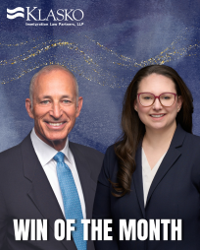
Win of the Month! This month’s Winning Wednesday celebrates a father and daughter who can finally move forward with certainty in the U.S. After their EB-5 I-829 was denied and they were placed in removal proceedings, Ilana Snyder, Ron Klasko, and the Klasko Litigation Team renewed the I-829 in Immigration Court and pursued Cancellation of Removal. The team navigated complex issues, including whether the investment created the required 10 U.S. jobs, and litigated the case through trial. After more than a decade in the U.S., the clients received their permanent 10-year green cards, which let them travel internationally again and put them on the path to citizenship. Read the full Instagram post here!
Stay Connected! Subscribe to our emails and follow us on Facebook, Instagram, and LinkedIn.
This newsletter was prepared with the assistance of ABIL, the Alliance of Business Immigration Lawyers, of which Klasko Immigration Law Partners is an active member.