DHS Finalizes Rule Eliminating Duration of Status for F, J, and I Nonimmigrants
On July 16, 2026, the Department of Homeland Security (DHS) released its long-anticipated final rule changing the admission period in the F, J, and I classifications from duration of status (D/S) to admission for a fixed time period tied to the nonimmigrant’s program, along with making additional changes to admission and extension requirements. The rule is effective September 15, 2026, although Congress could act to change or void the rule during the implementation window.
The new rule also introduces new restrictions on academic flexibility. Undergraduate F-1 students would be barred from changing their study program, major, or education level during their first year, except in rare cases. Graduate F-1 students would face even stricter limits, with no ability to change their program or field of study. Moreover, once an international student completes a program at a certain level, they would no longer be permitted to pursue another program at the same or a lower level under F-1 status.
The grace period for F-1 students has been halved from 60 days to 30 days. F-1 students enrolled in English language training programs will have a limited aggregate 24-month period of stay.
The final rule provides for transition measures for students already present in the United States. Those who are currently covered by D/S may continue to benefit from it through their current study program period or up to four additional years. However, if they travel abroad and return within the four years, they will be admitted under the fixed period of the academic program and be subject to the new 30-day grace period.
Under the rule, F, J, and I nonimmigrants will need to track fixed admission periods and timely file extension-of-stay (EOS) applications with U.S. Citizenship and Immigration Services (USCIS) to maintain status. Those who travel internationally and return to the United States will need to carefully monitor their I-94 admission dates and understand that the I-94 date, not the visa stamp date or any other indicator, controls their authorized stay in the United States.
For employers, universities, teaching hospitals, exchange programs, and media organizations, the rule introduces new compliance considerations and a formal extension process that did not previously exist under D/S. Employers with F, J, and I workers will need to adjust compliance and I-9 reverification procedures to account for fixed admission periods. Practitioners recommend doing this in several ways:
- Identify the population of employees working pursuant to F, J, or I status and track their status and I-94 expiration.
- Develop resources regarding employees’ obligation to monitor their I-94 expiration dates, explaining the nuances and common issues that arise with I-94 admission records. This should include noting that:
- I-94 expiration dates can be truncated, or shortened, to the date of a foreign national’s passport expiration. U.S. Customs and Border Protection does not consider this an error in admission that can be corrected. Foreign nationals must closely monitor their passport expiration dates and renew them as early as possible also.
- Truncated I-94 expiration dates are one of the easiest ways for a foreign national to fall out of status, lose work without authorization, and accrue unlawful presence in the United States.
- Determine what level of support the employer will provide, such as covering EOS or Employment Authorization Document filing costs and whether to extend support to dependents.
- Train I-9 professionals regarding these rule changes and how they will affect the I-9 reverification process and considering supplementing their I-9 support.
- Educate campus recruiting and talent acquisition teams on the roles of the organization, the employee, and the F/J sponsoring organization in maintaining immigration status and work authorization.
It is critical for individuals in F, J, or I status to understand that the I-94 expiration date controls authorized stay in the United States, even if a visa stamp remains valid for a longer period. Individuals considering program changes, transfers, new educational levels, Curricular Practical Training, Optional Practical Training strategy, extensions, or travel should consult with counsel or their Designated School Official before acting.
First Circuit Denies Stay in $100,000 H-1B Fee Case
On July 24, 2026, the U.S. Court of Appeals for the First Circuit denied a motion to continue a stay in State of California v. Mullin. In that case, plaintiffs (a group of 20 states[1]) challenged a proclamation by President Trump requiring that $100,000 be paid with each H-1B petition. The plaintiffs argued that the actions taken by several federal agencies to implement the proclamation were illegal and unconstitutional. They also claimed that the policy would harm their states and lead to staffing shortages in public universities, K-12 schools, and healthcare systems.
A district court previously vacated the policy as unlikely to succeed on the merits but granted a temporary administrative stay. The First Circuit agreed with the lower court and noted that the plaintiff states were likely to be substantially injured by the stay. The First Circuit’s order means that the $100,000 H-1B application fee remains vacated pending a decision on the merits in the underlying appeal. It is widely expected that the Trump administration will petition the Supreme Court if it loses on the merits in the First Circuit. A final First Circuit decision is not expected until some time in 2027.
[1] The plaintiff states are Arizona, California, Colorado, Connecticut, Delaware, Hawaii, Illinois, Maryland, Massachusetts, Michigan, Minnesota, Nevada, New Jersey, New York, North Carolina, Oregon, Rhode Island, Vermont, Washington, and Wisconsin.
USCIS Reaches FY 2027 H-1B Cap
On July 17, 2026, U.S. Citizenship and Immigration Services (USCIS) announced that it has received enough petitions to reach the congressionally mandated 65,000 H-1B visa regular cap and the 20,000 H-1B visa U.S. advanced degree exemption for fiscal year 2027.
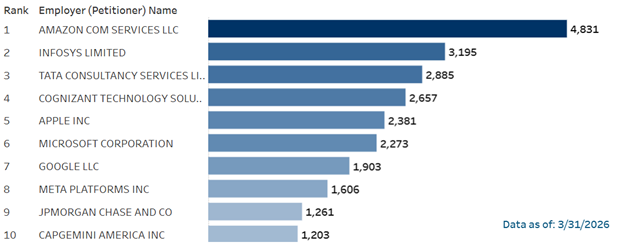
USCIS also released data showing the number of H-1B workers approved by companies as of March 31, 2026. Below are the top 10 companies hiring H-1B workers:
DOS Announces ‘B’ Visa Expedited Appointment Pilot Program, Starting With Mission Mexico
On July 22, 2026, the Department of State (DOS) announced that it is testing a voluntary, optional nonimmigrant visa expedited appointment program for B visas at select U.S. embassies and consulates through December 31, 2026, starting with Mission Mexico (embassy and all consulates).
Under the pilot program, eligible applicants for B visas—those making new appointments or holding existing appointments with unexpired machine-readable visa (MRV) fee receipts—may pay a $750 fee per appointment to schedule a visa interview within 10 business days (subject to availability). Applicants must first follow the usual process to pay the $185 MRV fee and schedule an interview appointment. If expedited appointments are available, these appointments will be visible for applicants to select when scheduling their appointments, DOS said. After an applicant selects an expedited appointment date and time, the $750 fee payment must be completed within 10 minutes to secure the appointment.
DOS noted that additional pilot locations may be announced throughout the pilot period.
No Immediate Changes to TN Visa; USMCA Review Process Begins
On July 1, 2026, the Trump administration announced that it will not renew the United States-Mexico-Canada Agreement (USMCA), triggering the agreement’s built-in six-year review process and beginning a potential 10-year path toward expiration.
Although this development has generated significant attention, there is no immediate impact to Trade NAFTA (TN) nonimmigrant status or the ability of Canadian and Mexican professionals to obtain TN classification. U.S. Customs and Border Protection and U.S. Citizenship and Immigration Services continue to adjudicate TN applications under existing eligibility standards. Employers should therefore continue regular workforce planning practices for current and prospective TN employees.
Under the treaty’s “sunset” provisions, the United States, Canada, and Mexico will engage in annual review discussions. If the parties do not agree to extend or replace it, USMCA would expire on July 1, 2036. This review process is separate from the treaty’s withdrawal provision, which would permit a member country to withdraw upon six months’ notice. No such withdrawal has been announced.
DHS Proposes to Implement EB-5 Reform and Integrity Act
On July 2, 2026, the Department of Homeland Security (DHS) published a proposed rule that would implement the EB-5 Reform and Integrity Act of 2022 (RIA), which former President Biden signed on March 15, 2022.
In addition to DHS’s general call for comments, the agency is specifically seeking comments on:
- Audits and a regional center’s record-keeping requirements;
- The types of projects that may meet the definition of an infrastructure project;
- The high unemployment area designation process, including the most appropriate data sources to calculate the weighted unemployment average of census tracts and how a regional center should renew the designation of a previously designated high unemployment area;
- Redeployment of alien investor capital, including the process a regional center should use to document its compliance with the statutory requirements; and
- The process for registering direct and third-party promoters of a regional center, new commercial enterprise, or job-creating entity.
DHS also invites comments on the economic analysis supporting the rule and the proposed form revisions. Written comments must be submitted by August 31, 2026.
DHS Rescinds Public Charge Regulation
On July 16, 2026, the Department of Homeland Security (DHS) announced that it has issued a final rule rescinding a 2022 regulation regarding public charge determinations. DHS said the rule “ensures that officers can make highly individualized, fact-specific, case-by-case public charge inadmissibility decisions based on the totality” of each person’s individual circumstances. “This approach will prevent the application of overly restrictive criteria that straitjackets DHS officers’ ability to make public charge inadmissibility determinations.”
DHS said that the rule applies to applications for admission made on or after September 18, 2026, or applications for adjustment of status postmarked or electronically submitted on or after that date. Receipt of means-tested public benefits before September 18, 2026, will be considered consistent with the 2022 final rule, DHS said.
The agency plans to publish a revised Form I-485, Application to Register Permanent Residence or Adjust Status. Older versions of Form I-485 postmarked or submitted electronically on or after the effective date will not be accepted, DHS noted.
E-Verify Announces TPS-Related Revisions to Handbook for Employers
On July 7, 2026, U.S. Citizenship and Immigration Services’ (USCIS) E-Verify program announced revisions to its M-274 Handbook for Employers related to Temporary Protected Status (TPS) changes.
Specifically, sections 5.0 through 5.3 have been revised due to developments that “have reduced or eliminated the automatic extension periods for qualifying TPS applicants and beneficiaries with TPS-based [Employment Authorization Documents (EADs)].” A DHS interim final rule, USCIS implementation of H.R. 1 (the “One Big Beautiful Bill Act”), and “Federal Register notices unique to specific countries” have affected various EAD categories, USCIS noted.
USCIS Again Moves Work Authorization Expiration Date for Certain TPS Recipients, Issues Guidance for Employers
On July 10, 2026, U.S. Citizenship and Immigration Services (USCIS)’ E-Verify program issued new guidance on work authorization for eligible Temporary Protected Status (TPS) recipients affected by a court order in Mullin v. Doe, a recent Supreme Court decision. The new guidance, which moves the expiration date for work authorization to July 17, 2026, for six countries and to July 24, 2026, for Haiti, supersedes USCIS’ guidance released on July 1 that extended work authorization for those seven countries to July 10, 2026.
The new guidance for employers of affected TPS beneficiaries from Burma (Myanmar), Ethiopia, Somalia, South Sudan, Syria, and Yemen includes the following instructions:
When completing the Expiration Date (if any) fields on Form I-9, input “as per court order” in Section 1 and “July 17, 2026” in Section 2 along with a note in the additional information box. Employers may download the Alert and TPS [country] webpages and attach them to Form I-9. Check USCIS websites regularly for updated information. When completing a case in E-Verify, enter the expiration date of “July 17, 2026” from the Form I-9.
The new guidance tells employers of affected Haiti TPS beneficiaries to use July 24, 2026, for the expiration date in the fields noted above. Confusion about the shifting dates and their impact has affected both employers and TPS recipients. A commenter noted that the new EAD expiration dates “are placeholder dates that [the Department of Homeland Security] may update as the remaining litigation and implementation efforts proceed.” In a July 7, 2026, press release, Massachusetts Attorney General Campbell stated, “While the Supreme Court’s decision allows the federal government to terminate TPS protections for Haiti and Syria, the current TPS designations and related work authorizations remain in effect until the Supreme Court sends a certified copy of its judgment to the lower court and the federal administration issues implementation guidance.”

Ireland: Temporary Relief Extended for IRP Renewal Delays
Ireland’s Department of Justice, Home Affairs and Migration office has extended interim measures to address delays in Irish Residence Permit (IRP) card renewal processing. Applications are currently being processed strictly in order of submission date within each stamp category due to a high volume of renewals.
Under the extension, announced on July 13, 2026, non-EEA nationals who applied to renew their permission before their existing IRP card expired may continue to travel internationally on the expired card, provided they carry the accompanying travel notice, through August 31, 2026. Employment permit holders in the same position may continue working under their existing permission conditions during this period, provided their employment permit remains valid.
After August 31, 2026, expired IRP cards will no longer be accepted for travel or re-entry, and the standard twelve-week Notice to Employers policy will resume for pending renewal applicants.
South Africa: Trusted Employer Scheme Expands to New Sectors
South Africa’s Department of Home Affairs has formally published Phase II of the Trusted Employer Scheme (TES) in the Government Gazette, extending it to companies in strategic infrastructure projects, businesses establishing regional or global headquarters in South Africa, and qualifying financial services firms. Phase II introduces a dedicated online application portal, which the Department plans to eventually integrate into the country’s forthcoming Electronic Travel Authorisation (ETA) platform. Expressions of interest opened July 20, 2026, and close September 4, 2026, with an interdepartmental committee assessing applications. The scheme’s risk-based approach lets accredited employers move faster on visas for critical skills.
Canada: Permanent Residence Sponsorship Applications Under the Parents and Grandparents Program Pause Update
IRCC is pausing new applications under the Parents and Grandparents Program (PGP) until further notice. The government says the move is meant to support a well-managed, sustainable immigration system. Existing applications will continue to be processed, with up to 15,000 people expected to be approved for permanent residence through the program in 2026, in line with the 2026–2028 Immigration Levels Plan. New interest to sponsor forms will not be accepted, and no new sponsors will be invited to apply while the pause remains in effect. Parents and grandparents can still visit Canada through the super visa, which allows stays of up to five years per visit and multiple entries over ten years. IRCC recently eased the super visa’s income and health insurance requirements.
Canada: Quebec Sets New Two-Year Cap on Family Sponsorship
Quebec reopened intake for capped family sponsorship applications on July 2, 2026, through June 30, 2028. The province is accepting a maximum of 15,700 applications for undertakings to sponsor family members for permanent residence, with 13,300 allocated for spouses and 2,400 for parents or grandparents. If the maximum number of applications is reached in either subcategory before June 30, 2028, the Ministère de l’Immigration, de la Francisation et de l’Intégration (MIFI) will stop accepting applications in that subcategory for the remainder of the period.
According to the press release, the MIFI will prioritize older applications once the intake opens, and new applicants must submit their applications by mail.
The cap does not apply to undertakings to sponsor dependent children, orphaned minor children, or children being adopted, nor does it apply to the addition of dependents to an application that includes a family member covered by an existing undertaking. Dependent children aged 18 or older will no longer be subject to the cap for family sponsorship in Quebec.
Brazil: Temporary Visa Waiver Introduced for Chinese Nationals
Brazil’s Ministry of Foreign Affairs has waived visitor visa requirements for Chinese nationals holding a regular passport, which went into effect on May 11, 2026, through December 31, 2026. The measure is reciprocal, matching a visa waiver China previously extended to Brazilian nationals. Under the waiver, eligible Chinese travelers may enter Brazil for stays of up to 30 days without obtaining a visa in advance; trips exceeding 30 days still require a visitor visa through the standard application process.
Klasko News
FIRM NEWS
Klasko Webinar: Paperwork to Protection: Is Your Compliance Program Ready?
On August 5, join Klasko Immigration Law Partners for this webinar as attorneys Nick Lowrey, Natalia Gouz, and Tim D’Arduini unpack the current enforcement landscape and walk through practical strategies for an internal compliance evaluation. Register here!
RECENT SPEAKING ENGAGEMENTS
H. Ronald Klasko
On July 16, Ron Klasko presented in a Civitas webinar titled The EB-5 Impact of the New USCIS NPRM Proposal.
Timothy D’Arduini
On July 21, Timothy D’Arduini spoke at the I-9 Palooza Virtual Conference on a panel titled E-Verify Updates: State Mandates, Audits, and Upcoming Changes.
H. Ronald Klasko
On July 28, Ron Klasko spoke in an EB5AN webinar titled USCIS Notice of Proposed Rulemaking Under the EB-5 Reform and Integrity Act.
UPCOMING SPEAKING ENGAGEMENTS
Timothy D’Arduini | Natalia Gouz | Nick Lowrey
On August 5, Tim, Natalia, and Nick will be hosting a Klasko Immigration Law Partners webinar on I-9 compliance and worksite enforcement entitled Paperwork to Protection: Is Your Compliance Program Ready?
Timothy D’Arduini
On August 16, Tim will be presenting in a webinar hosted by LawPractice CLE titled I-9 Penalty Reclassification and ICE Worksite Enforcement: Defending Employers After the Virtue Memorandum’s Repeal.
Nigel James
Nigel will be speaking at this myLawCLE webinar on USCIS’s recently updated discretionary policy for employment-based green card adjustment of status filings. For free access, please use this code when registering: EmployerGreenCardCLE.
ICYMI: RECENT BLOG POSTS AND ALERTS
Domestic Travel Advisory: Increased Risk of Airport Detentions
Nigel James and Elise Fialkowski cover which employees are most at risk and the immediate steps employers and foreign nationals should take before any domestic travel plans are finalized. Read the alert here.
Charting a New Path for Healthcare Worker Certification
Klasko attorneys William Stock and Ryan Patterson secured USCIS approval for The Evaluation Company to issue Health Care Worker Certifications for international nurses through its new VisaKey program, making TEC only the fourth organization ever certified to do so. Read the case study here.
DHS Rescinds 2022 Public Charge Rule
Grace Waweru outlines what the new standard means for applicants, who is most at risk, and what individuals pursuing permanent residence should evaluate before the rule takes effect. Read the alert here.
Becoming a US Citizen: The Basics of Naturalization
Megan Kludt, Stacy Shore, and Karuna Simbeck break down what it means to become a US citizen, and why the topic feels especially timely right now. Read the blog here.
DHS Finalizes Rule Eliminating Duration of Status for F, J, and I Nonimmigrants
Allie Dempsey and Timothy D’Arduini outline the key provisions, what the change means for affected foreign nationals and the organizations that sponsor them, and the immediate steps employers and institutions should take to prepare. Read the alert here.
A SCOTUS Trifecta: What the June Decisions Mean for Immigrants
Megan Kludt unpacks each decision and what green card holders, TPS holders, and employers should be watching as lower courts begin applying these rulings. Read the article here.
The EB-5 Notice of Proposed Rulemaking: Top 10 Concerns
Ron Klasko breaks down the top 10 areas of concern, from bridge financing restrictions to I-829 denial consequences, and what investors should consider before the public comment period closes August 31. Read the blog here.
USMCA Review Process Begins; No Immediate Changes to TN Visa
Carolina Ribas explains what the USMCA review process means for TN visa holders and their employers, and the guidance TN professionals should keep in mind as negotiations unfold. Read the alert here.
Adjustment of Status vs. Consular Processing?
Natalia Gouz and Jessica DeNisi unpack USCIS’s May 2026 policy memo on adjustment of status, examining what the memo says, what’s played out in practice in the weeks since its release, and what it could mean for anyone weighing their green card options. Read the blog here.
FIRM FEATURE
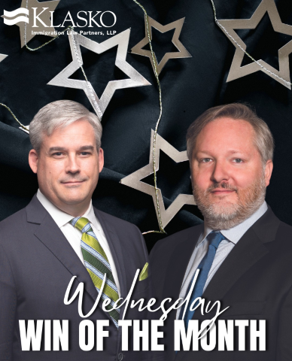
Win of the Month! Thanks to the work of Klasko attorneys William Stock and Ryan Patterson, USCIS approved The Evaluation Company (TEC) on March 26 to issue Health Care Worker Certifications for international RNs and LPNs through its new VisaKey program. The I-905 approval makes TEC only the fourth organization ever certified, opening new pathways for skilled nurses to join the U.S. healthcare workforce. Congratulations, TEC! Read the full Instagram post here!
Stay Connected! Subscribe to our emails and follow us on Facebook, Instagram, and LinkedIn.
This newsletter was prepared with the assistance of ABIL, the Alliance of Business Immigration Lawyers, of which Klasko Immigration Law Partners is an active member.